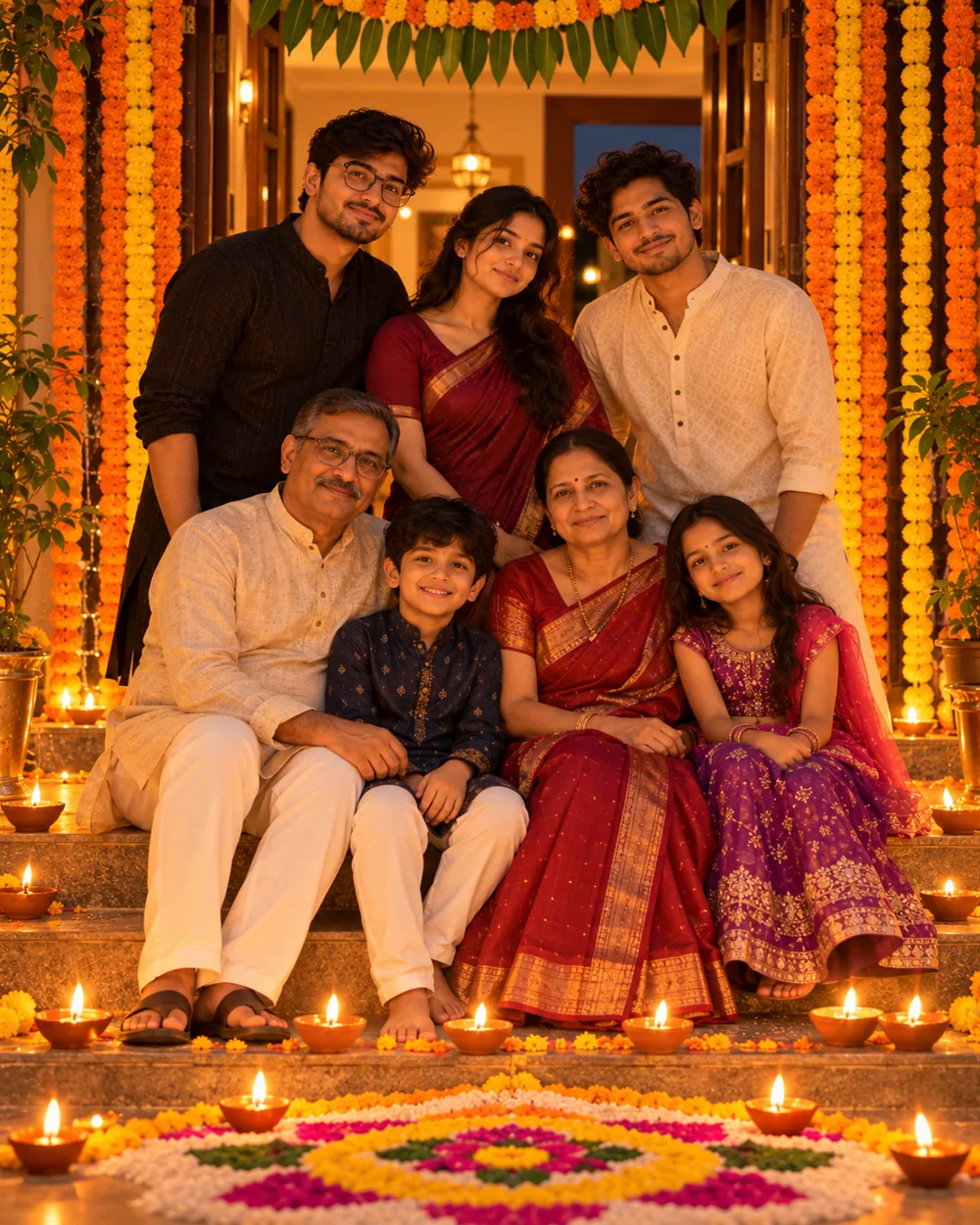
Diwali AI Photo Editing Prompts for Your Own Photo: 6 Diya-Lit Edits for 2026
- • Introduction
- • Choose the right source photo
- • Instructions that hold a face in place
- • How diya and candle light really behaves
- • Describe traditional outfits accurately, without reshaping your body
- • Step-by-Step: How to Use These Prompts
- • Prompt 1: Solo Portrait on a Diya-Lit Balcony
- • Prompt 2: Outfit Change to a Silk Saree at a Marigold Doorway
- • Prompt 3: Couple Behind a Rangoli in a Home Courtyard
- • Prompt 4: Friends on a Lantern-Lit Terrace
- • Prompt 5: Family Portrait at a Marigold-Decorated Entrance
- • Prompt 6: Calm Celebration Without Fireworks, Holding a Diya
- • Group photos: keeping every face right
- • Why these scenes skip sparklers and smoke
- • Problems & Fixes
- • Pro Tips
- • Frequently Asked Questions
Diwali 2026 falls on Sunday, 8 November, with Lakshmi Puja that evening (puja timings differ by city, so check a local panchang). Many festival photos, though, are taken under a white tube light.
ChatGPT and Gemini can move a photo you already have into a diya-lit balcony, a rangoli courtyard or a marigold doorway. The risk is that the tool quietly 'improves' you: a slimmer face, lighter skin, a cousin who looks like a stranger.
This guide covers the source photo, wording that holds a face in place, how diya light behaves, traditional outfits and group photos. None of the six prompts place deities or religious figures in the image.
Choose the right source photo
The AI can only keep what it can see. If your face is small, shadowed or blurred, the tool guesses, and guesses are where faces change. Daylight photos often work better than night ones: adding warm light is easier than recovering detail from a dark, noisy image.
- •Faces should be large and sharp, not hidden by sunglasses, hair or a phone.
- •Pick an expression you like; the prompts keep it as it is.
- •For an outfit change, use a photo that shows you at least from the waist up.
- •Avoid beauty-filtered originals, and upload only photos of yourself or of people who agreed. For children, the parent decides.
Instructions that hold a face in place
Image editors redraw the whole picture, using your photo as a guide. A vague 'make it Diwali themed' lets the tool redraw your face too, drifting towards an average, smoothed, often lighter-skinned face.
So each prompt starts with a 'keep' list (face, features, skin tone, hairstyle, body shape, pose, expression), then a 'change only' line, then bans the usual 'improvements' by name: no beautifying, slimming, skin smoothing or age change. Ask for one big change per turn.
How diya and candle light really behaves
A diya or candle flame is very warm light, roughly 1,800 to 2,000 kelvin, against about 5,500 to 6,500 kelvin for daylight. On skin that means deep orange-gold. 'Festive lighting' alone often gives flat light with an orange tint.
Small flames also fade fast. Following the inverse-square law, a face twice as far from a diya gets about a quarter of the light, so real diya portraits have a bright side and a soft fall into shadow. Diyas sit low, so the glow lands under the chin and on the cheekbones, and a flame leaves tiny bright reflections in the eyes, called catchlights. Finally, warm light looks warmest against cool blue dusk, which is why most prompts here ask for a deep blue sky behind you.
Describe traditional outfits accurately, without reshaping your body
Describe the garment the way a tailor would, with fabric, colour and drape, then tell the tool to fit it to your existing body. Otherwise editors often draw a standard figure under the new clothes.
Use accurate words so garments are not mixed up. A saree is a long draped cloth worn with a blouse; the common Nivi drape takes the pallu over the left shoulder. A lehenga is a long flared skirt with a fitted choli and a dupatta. A kurta is a long tunic, often worn with churidar and sometimes a sleeveless Nehru jacket. A sherwani is a structured, usually knee-length coat worn over churidar, more formal than a kurta. Keep to one or two colours and one border detail.
Step-by-Step: How to Use These Prompts
- 1Pick a clear, well-lit photo and crop out anyone who has not agreed.
- 2In ChatGPT, tap the + button in the message box and add your photo. In Gemini, use Add files. Gemini's help page says image editing is only for users aged 18 or over.
- 3Paste one prompt; change colours if you like, but keep the opening 'keep' list.
- 4Compare the result with your original at full size: eyes, nose, jawline, skin tone and hairline, one at a time.
- 5Fix one problem per reply, for example 'Keep everything else; restore my original skin tone.'
- 6If the face keeps drifting, start a new chat with the original photo; editing an edit moves it further from your real face.
6 Diwali Photo-Edit Prompts for Your Own Photo
Copy a prompt, then use the button to open the tool it was written for.
Prompt 1: Solo Portrait on a Diya-Lit Balcony
Written for: ChatGPT / Gemini · upload your own photo with this prompt
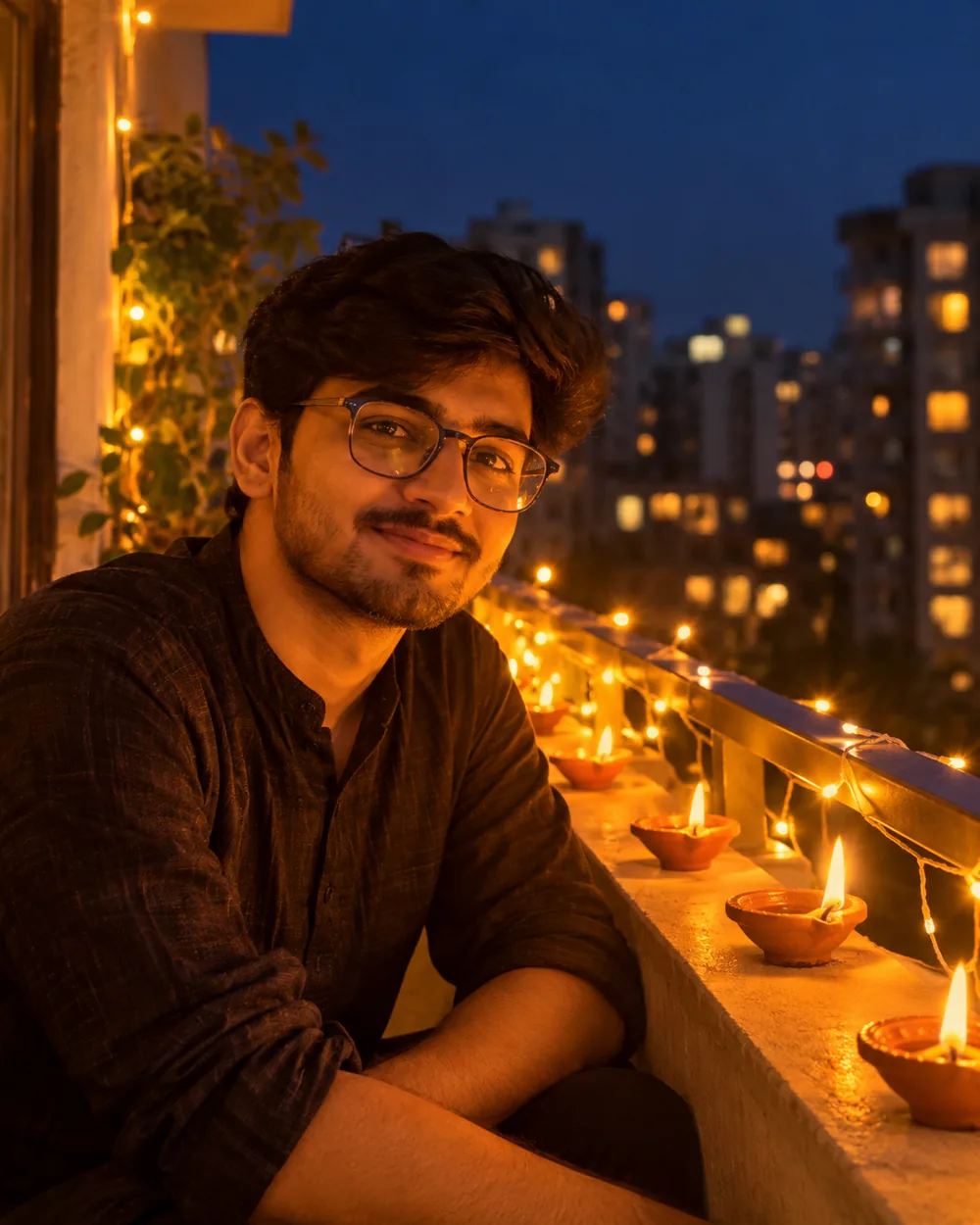
Edit the uploaded photo. Keep the person exactly as they are: same face, facial features, skin tone, hairstyle, body shape, pose, expression and clothing. Do not beautify, slim, smooth the skin or change their age. Change only the setting and the light. Place them on a small apartment balcony on Diwali evening, with a row of lit clay diyas along the balcony ledge beside them and warm string lights wound around the railing. The diyas are the main light: deep warm orange flame light, about 1,900 kelvin, falling on the side of the face nearest the ledge and fading quickly into soft shadow on the far side, with small warm catchlights in both eyes. Behind them, a deep blue evening sky and the softly blurred, warmly lit windows of neighbouring buildings. Realistic low-light photograph with natural skin texture and slight grain. No fireworks, no smoke, no text, no idols or religious figures. Vertical 4:5 frame.
Why this prompt works
'Change only the setting and the light' limits what may be redrawn. 'About 1,900 kelvin' and 'fading quickly into soft shadow' describe real flame colour and falloff, so the face gets shape instead of an even orange wash.
Make it yours
- •Use 'window seat inside a room' if your photo is indoors.
- •Move the diyas 'on the floor in front of them' to light the face from below.
- •Use 'clean, low-noise' instead of 'slight grain' for a crisper look.
Prompt 2: Outfit Change to a Silk Saree at a Marigold Doorway
Written for: ChatGPT / Gemini · upload your own photo with this prompt
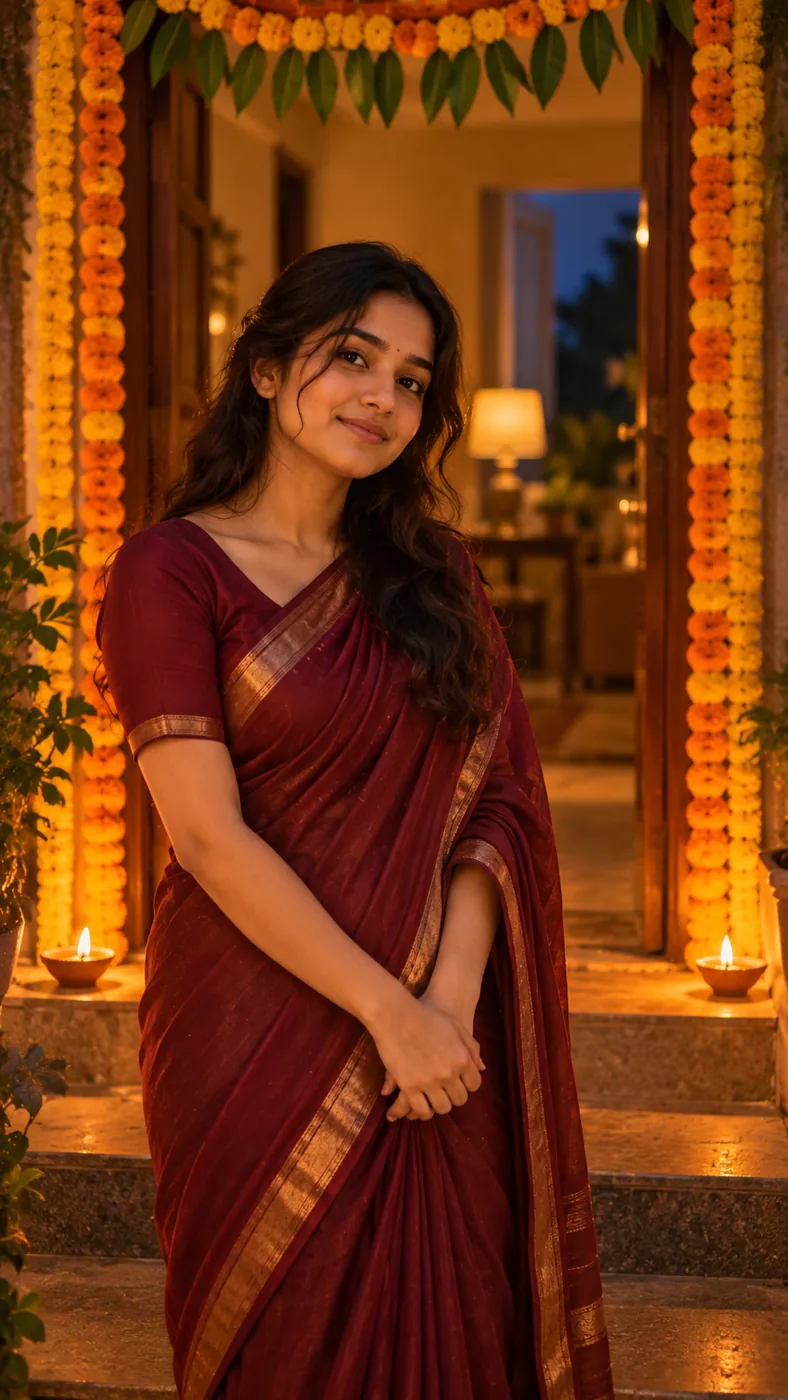
Edit the uploaded photo. Keep the person's face, facial features, skin tone, hairstyle, height, body shape and proportions exactly the same, and keep the same pose and expression. Keep any jewellery, glasses or bindi from the original photo and do not add new ones. Change only the clothes and the background. Dress them in a deep maroon silk saree with a narrow gold zari border, draped in the Nivi style with the pallu over the left shoulder, worn with a matching short-sleeved blouse. The saree sits naturally on their existing body; do not change their waist, arms or figure. Background: the front door of a home framed with fresh orange and yellow marigold garlands and a mango-leaf toran across the top, with one lit clay diya on the floor on each side of the doorstep. Warm diya light from below and in front, soft warm lamp light from inside the house behind them, deep blue dusk outside. Realistic photograph, natural skin texture, three-quarter length, vertical 9:16 frame. No idols or religious figures, no text.
Why this prompt works
'Height, body shape and proportions' plus 'sits naturally on their existing body' make the tool fit the saree to you instead of drawing a new figure. 'Nivi style with the pallu over the left shoulder' names a real drape, and the jewellery line stops unrequested necklaces and earrings.
Make it yours
- •Lehenga: replace both saree sentences with 'a bottle-green silk lehenga, fitted choli and sheer dupatta that sit naturally on their existing body'.
- •Kurta or sherwani: do the same with 'an ivory kurta, churidar and mustard Nehru jacket' or 'a knee-length cream silk sherwani over churidar'.
- •Use 'waist-up' if your photo shows less of your body.
Prompt 3: Couple Behind a Rangoli in a Home Courtyard
Written for: ChatGPT / Gemini · upload your own photo with this prompt
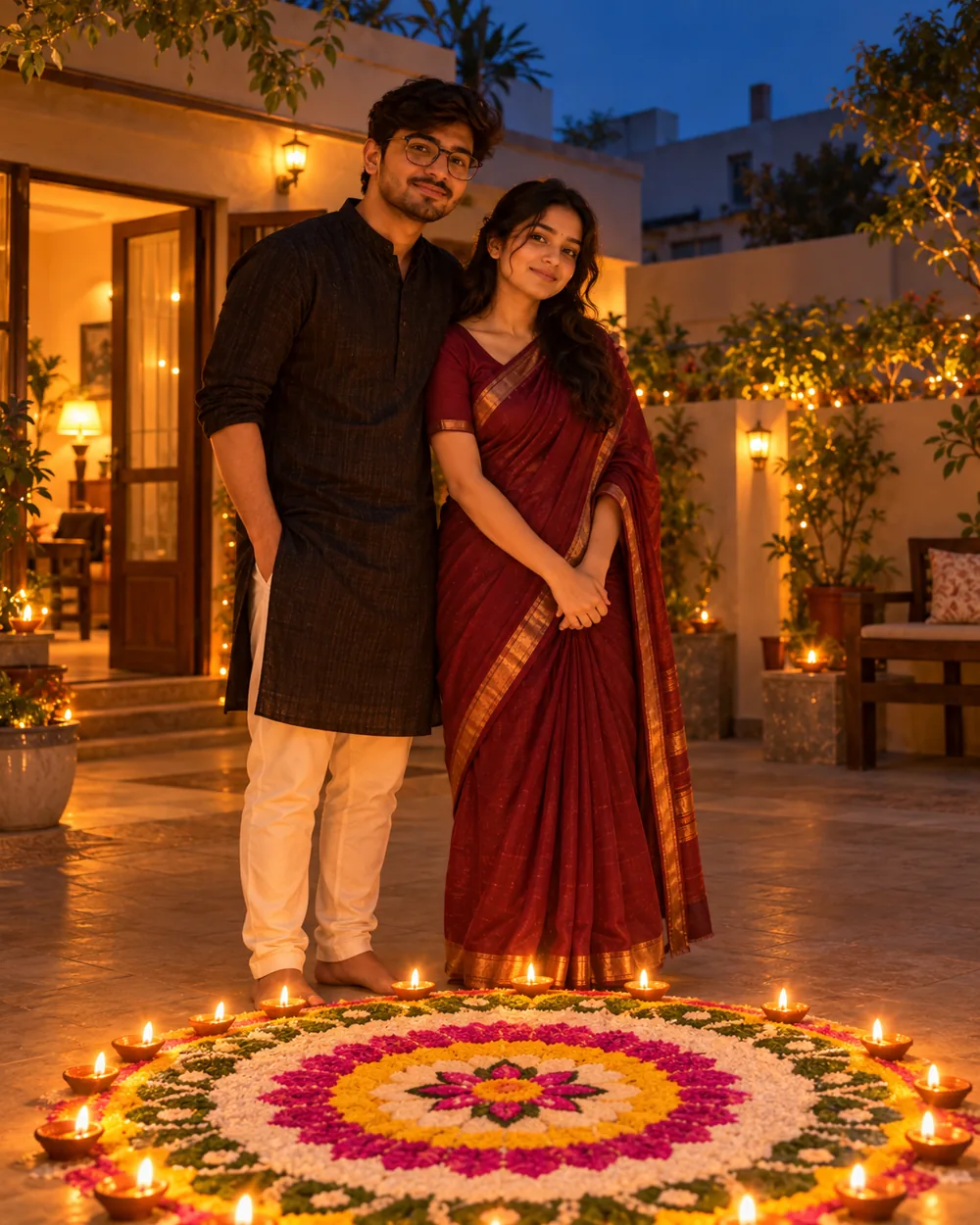
Edit the uploaded photo of two people. Keep both people exactly as they appear: each person's face, facial features, skin tone, hairstyle, body shape and clothing, the height difference between them, and who stands on the left and who stands on the right. Do not blend or swap features between the two faces, and do not beautify either person. Change only the location and the lighting. Place them standing side by side in an open-air home courtyard in the early evening, just behind a large, freshly made circular rangoli on the floor in white, magenta, yellow and leaf-green powder, with a ring of lit clay diyas around its edge. The diyas light their clothes and the lower part of their faces softly from in front and below, and warm light from an open doorway behind them adds a gentle rim of light on their hair and shoulders. Dusk-blue sky above the courtyard walls. Both faces sharp and in focus. Realistic photograph, natural skin. No fireworks, no smoke, no text, no idols or religious figures. Vertical 4:5 frame.
Why this prompt works
Editors sometimes average two faces, so 'do not blend or swap features' and the left-right line protect each person. Diyas in front plus a 'rim of light' from the doorway behind is a two-source setup that separates the couple from the background.
Make it yours
- •Try rangoli colours 'orange, white and deep blue' for a calmer palette.
- •Use 'sitting on the courtyard steps' only if your photo is seated too.
- •Add 'a brass urli bowl of floating marigold petals beside the rangoli' for an extra detail.
Prompt 4: Friends on a Lantern-Lit Terrace
Written for: ChatGPT / Gemini · upload your own photo with this prompt
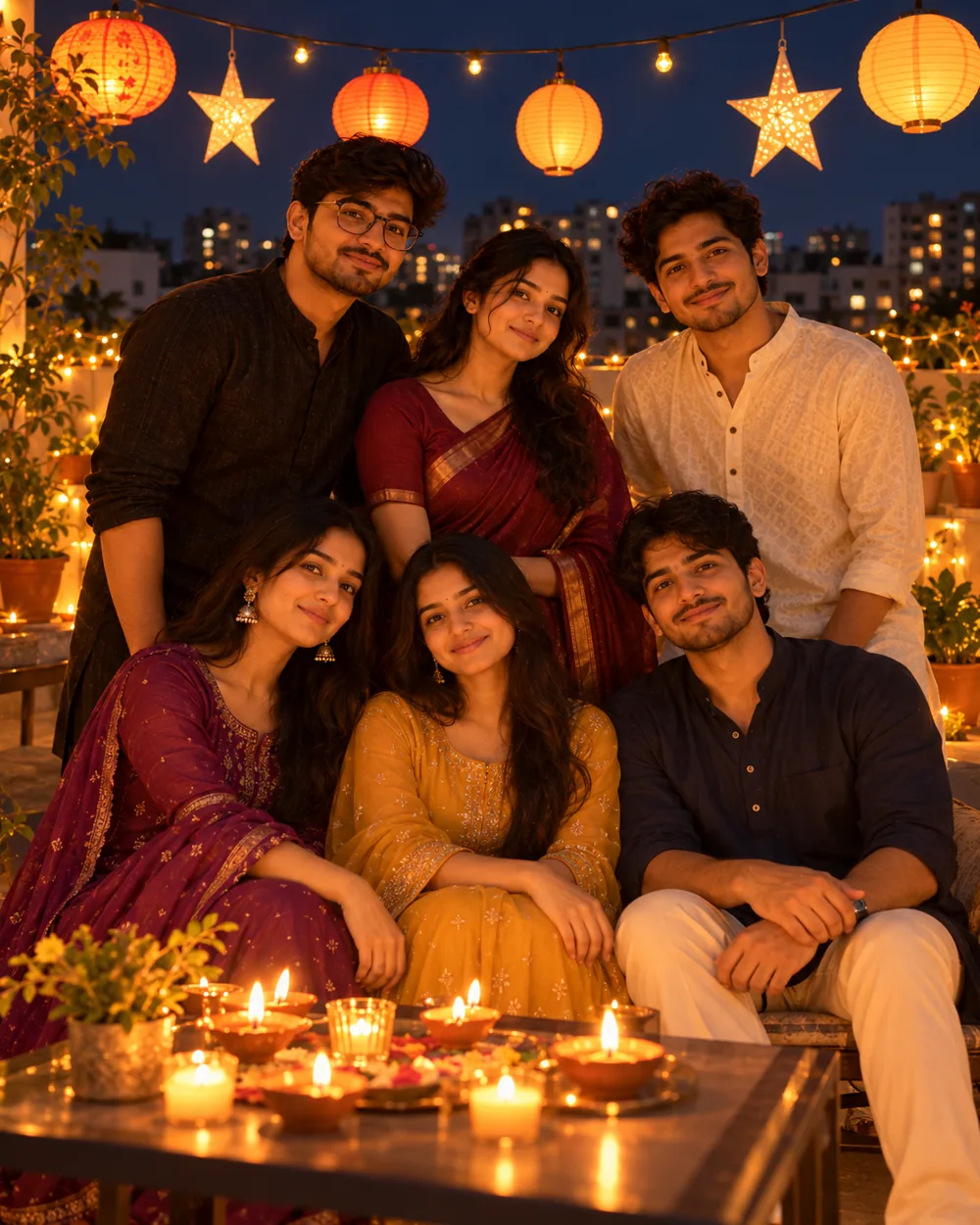
Edit the uploaded group photo. Keep every person exactly as they appear: the same faces, facial features, skin tones, hairstyles, body shapes, clothes and expressions, in the same left-to-right order. Keep the same number of people; do not add, remove or duplicate anyone. Do not beautify anyone. Change only the setting and the light. Place the group on a rooftop terrace on Diwali night, with handmade paper lanterns, some star-shaped and some round, hanging on a string above them, warm fairy lights along the low parapet wall, and a small table in front of the group holding lit clay diyas and a few tea-light candles. Every face is clearly visible and evenly lit: warm glow from the candles in front and a softer orange glow from the lanterns above. Behind them, the city is softly out of focus with scattered warm window lights under a clear dark-blue sky. Realistic photograph, natural skin, slight low-light grain. No fireworks, no sparklers, no smoke, no text, no idols or religious figures. Vertical 4:5 frame.
Why this prompt works
'Keep the same number of people' targets the most common group-edit failure. 'Every face is clearly visible and evenly lit' overrides natural flame falloff, which would leave people at the edges in darkness, and one shared table of candles lights everyone from the same direction.
Make it yours
- •For a bigger group, use 'a long low table' so the candlelight spreads across everyone.
- •Swap the lanterns for 'a canopy of warm white fairy lights' for less colour overhead.
- •Use 'ground-floor garden' if your photo was taken at ground level.
Prompt 5: Family Portrait at a Marigold-Decorated Entrance
Written for: ChatGPT / Gemini · upload your own photo with this prompt
Edit the uploaded family photo. Keep every family member exactly as they appear, including children and elders: the same faces, ages, facial features, skin tones, hairstyles, body shapes, clothes, glasses and expressions, and the same arrangement of who stands, who sits and who is next to whom. Keep the same number of people. Do not make anyone look younger, older, slimmer or fairer. Change only the background and the light. Place the family at the entrance of their home on Diwali evening: a doorway decorated with thick orange and yellow marigold garlands and a mango-leaf toran, a small rangoli on the doorstep, and lit clay diyas lined along the front steps. Warm diya light from below and in front, warm lamp light spilling from inside the house, and every face clearly lit and in focus. Realistic family photograph, natural colours and skin texture. No fireworks, no smoke, no text, no idols or religious figures. Vertical 4:5 frame.
Why this prompt works
In family edits, grandparents tend to get younger, children older and everyone fairer; 'younger, older, slimmer or fairer' bans all four. Keeping 'who stands, who sits and who is next to whom' preserves the family's real positions.
Make it yours
- •Use 'the living room, beside a window lined with diyas' for an indoor version.
- •Try 'white jasmine and orange marigold strings' for a lighter palette.
- •Add 'keep the frame wide so nobody is cropped' for a large family.
Prompt 6: Calm Celebration Without Fireworks, Holding a Diya
Written for: ChatGPT / Gemini · upload your own photo with this prompt
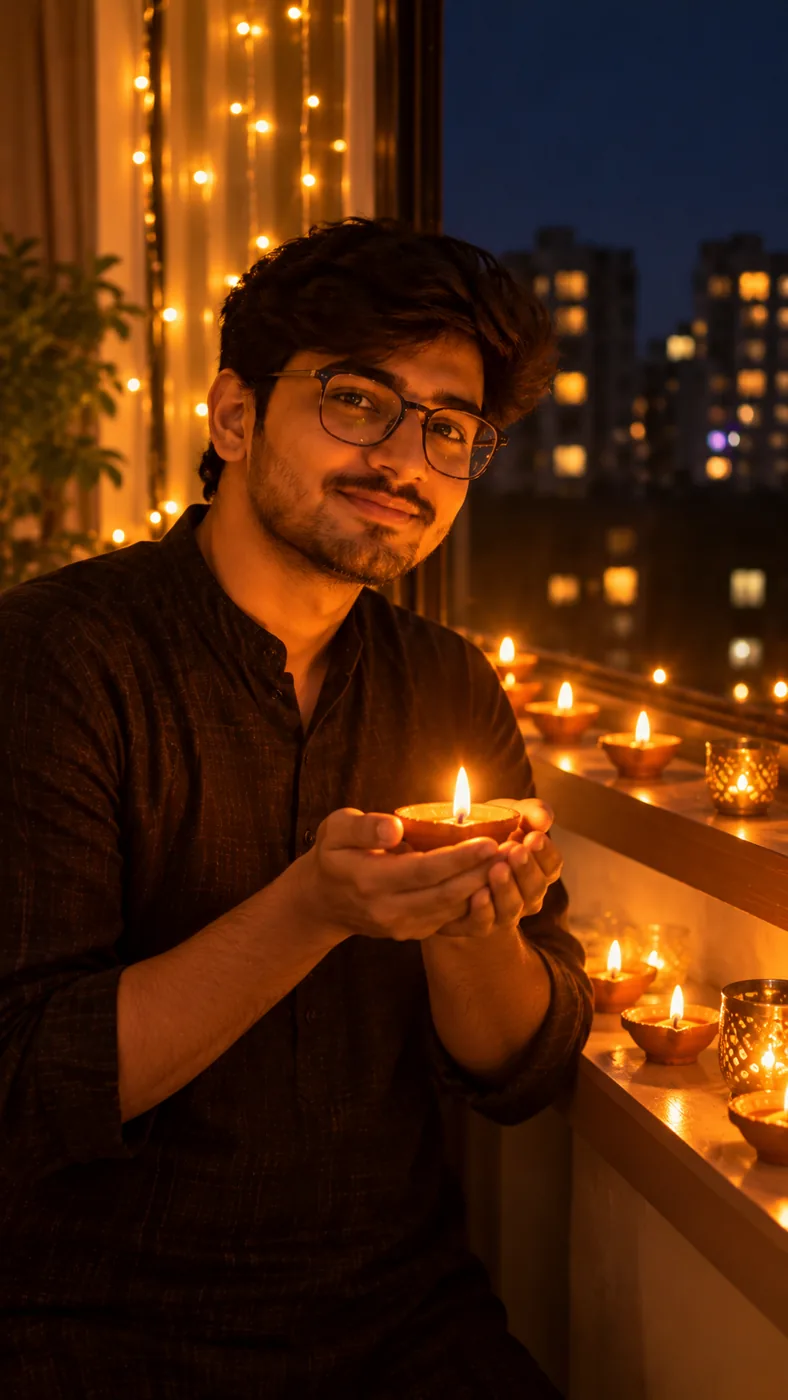
Edit the uploaded photo. Keep the person's face, facial features, skin tone, hairstyle, body shape, clothing and expression exactly the same, and do not beautify them. Adjust only the hands and forearms so they gently hold one lit clay diya at chest height, cupped in both palms. Change the background to a quiet window ledge at night lined with more lit diyas and a curtain of warm fairy lights. The diya in their hands is the main light: warm orange glow on the palms, chin, cheeks and the underside of the nose, with small warm catchlights in both eyes and the rest of the room in soft darkness. Clear night outside the window with no smoke or haze. Realistic photograph, natural skin texture, slight low-light grain. No fireworks, no sparklers, no firecrackers, no text, no idols or religious figures. Vertical 9:16 frame.
Why this prompt works
This is the only prompt that changes pose, and 'adjust only the hands and forearms' keeps that change small. A flame at chest height lights from below, so naming 'the underside of the nose' asks for the right shadows. Listing sparklers and firecrackers separately helps, because some tools add them when they see the word Diwali.
Make it yours
- •If the face changes when the hands move, use 'place a lit diya on a ledge just in front of them' instead.
- •For a couple, write 'both people hold one diya between them' and add Prompt 3's protection line.
- •Swap the clay diya for 'a small brass diya' for a metallic gleam.
Group photos: keeping every face right
Every extra person is another face to redraw, and small faces are where editors fill in generic features. Crop tightly before uploading, or edit two smaller groups instead of one large one.
Count the people in the result, then check each face at full zoom. If one person drifts, name their position: 'Keep everything else; make the second person from the left match the uploaded photo exactly.' Before posting, show the edit to the people in it.
Why these scenes skip sparklers and smoke
Air quality in many north Indian cities is already poor in early November, and studies of Delhi have linked firecracker use around Diwali to short-term rises in fine-particle (PM2.5) pollution. Rules on which crackers are allowed, and when, vary by state and change from year to year.
AI sparklers also often look pasted on, while diyas give softer light that suits faces. If you shoot your own source photos near real diyas, keep a saree pallu or dupatta well clear of the flames.
Problems & Fixes
| Problem | Fix |
|---|---|
| The face looks like a different person. | Start a new chat and upload the original again instead of correcting the edit. If it still drifts, drop the outfit or pose change and ask for background and light only. |
| My skin came out lighter or smoother than in real life. | Reply: 'Restore my exact skin tone and natural texture from the uploaded photo; the warm light should tint the skin, not lighten it.' |
| The whole picture is flat orange. | Ask for a deep blue dusk background and soft shadow on the far side of the face. Without contrast, warm light looks like a colour filter. |
| Someone in the group is missing, duplicated or merged. | State the count and order: 'There are five people, left to right; keep all five exactly as in the photo.' If it keeps failing, crop tighter or split the group. |
Pro Tips
- •Change background and light first, and do any outfit change in a separate turn.
- •Check the result on the phone you will post from, but also zoom in; small screens hide face drift.
- •Keep the original next to the edit, and add a short note like 'AI-edited from our Diwali photo' when you share it.
Frequently Asked Questions
When is Diwali in 2026?
Sunday, 8 November 2026, with Lakshmi Puja performed that evening. The exact muhurat differs by city, so check a local panchang.
Should I use ChatGPT or Gemini?
Both let you upload a photo and describe the change, and results vary by photo, so try both. Gemini limits image editing to users 18 and over, and free limits in both tools change over time.
Is it okay to upload photos of family or friends?
Only if they agreed, and for children, only with a parent's approval. Your photo is processed by the tool's provider, so check the app's privacy settings first, and avoid photos showing house or vehicle numbers.
Why don't these prompts include gods or idols?
AI tools can render religious figures inaccurately, and some people consider generated images of deities disrespectful. Diyas, rangoli, marigolds and lanterns carry the festive feeling without that risk.
Sample images on this page are AI-generated. AI tools change often, so results can differ from the samples. See our editorial & AI policy for how guides are written and corrected.